Coinbase Layoffs Signal a Bigger Shift: The Rise of AI Organizational Structure

AI is not just automating tasks. It’s reshaping how companies are structured.
Organizations like Coinbase are flattening organizational hierarchies, eliminating middle management, and shifting toward smaller, AI-native teams.
The result is a new organizational structure built for speed, where fewer reporting lines and broader employee roles replace traditional org charts.
What Is an AI Organizational Structure?
An AI organizational structure is a company design model that uses artificial intelligence to streamline workflows, reduce management layers, and increase execution speed. It replaces traditional hierarchical org charts with flatter team structures, broader employee roles, and AI-supported decision-making.
AI shifts structure from hierarchy to execution
AI organizational structure replaces traditional hierarchical org charts with systems designed for faster output.
Instead of optimizing reporting structures and coordination, companies are prioritizing execution speed and decision support powered by artificial intelligence.
Fewer layers, higher expectations per role
Organizations are reducing layers of middle managers and redefining job roles.
Employees are expected to operate with greater autonomy, using AI tools to increase output without expanding team size.
AI becomes part of the operating model
AI is embedded into workflows, shaping how teams are designed and how decisions are made.
The shift to AI-native organization design is not theoretical — it reflects how work is already being executed inside high-performing teams.
Why Are Companies Flattening Their Organizational Structure for AI?
Companies are flattening their org structures for AI because coordination costs are becoming a bottleneck, speed is the primary competitive advantage, and orgs are looking to Coinbase as a case study in structural design.
Coordination costs are becoming the bottleneck
Traditional organizational hierarchies rely on multiple layers of oversight.
As AI accelerates execution, these layers introduce friction.
Speed is becoming the primary competitive advantage
Organizations are restructuring to reduce latency between idea and execution, especially in large organizations.
Coinbase as a case study in structural redesign
By reducing management layers and increasing span of control, Coinbase is aligning its organizational structure with AI-driven workflows.
And it’s not just happening with Coinbase as manager spans are increasing across organizations, averaging 12.1 employees per manager, up from 10.9 in 2024.
This illustrates that flattening is not just intentional and that it is already happening at scale.
Traditional vs AI Organizational Structure (Visual Comparison)
Below is a traditional organizational chart structure, defined by layered reporting lines, narrow spans of control, and clearly separated role titles.
Traditional Org Structure Visual
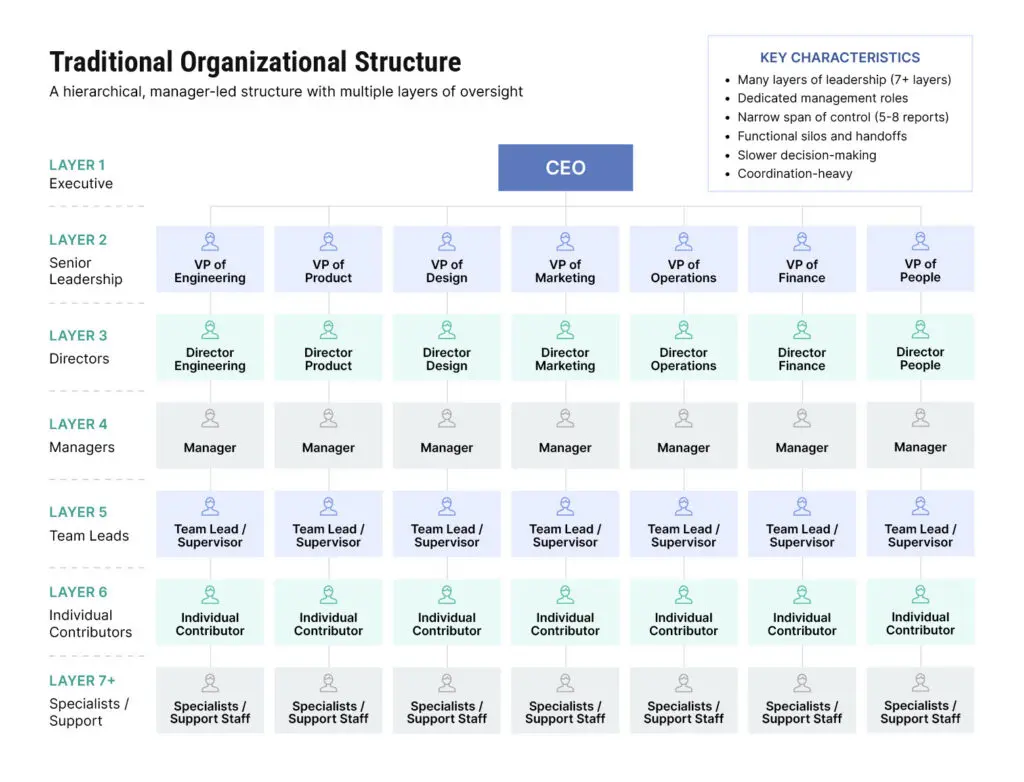
This model emphasizes:
- Multiple layers of middle management
- Rigid department groupings
- Hierarchical org charts with strict reporting structures
- Slower decision-making due to coordination overhead
Now compare that to an AI Organizational Structure chart:
AI Organizational Structure Visual
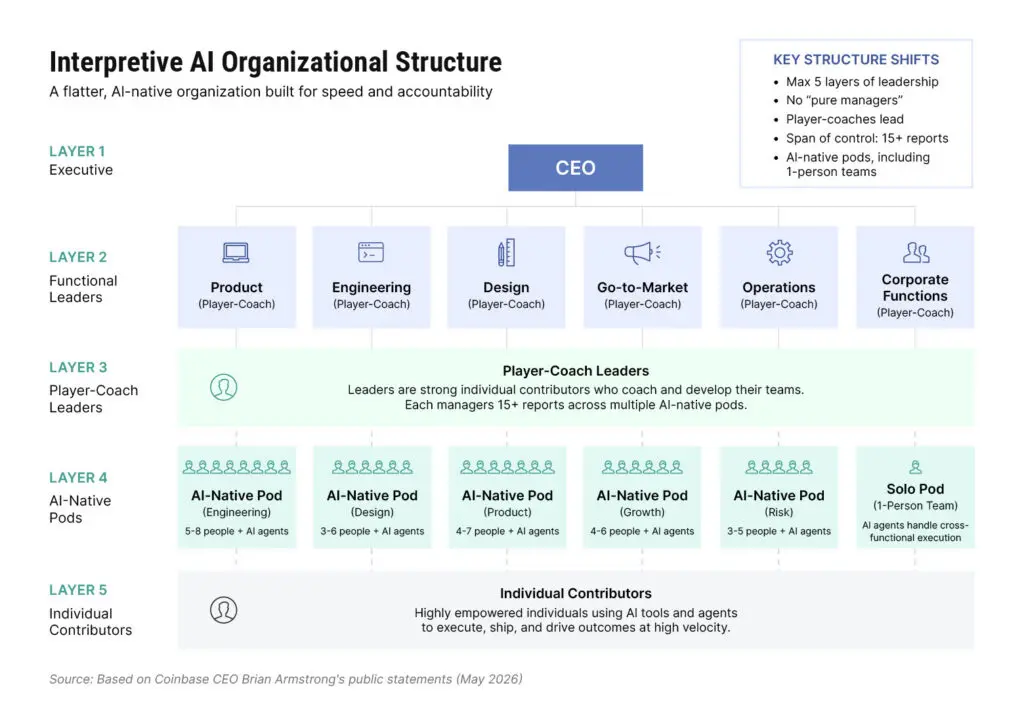
This emerging AI org chart reflects:
- Fewer layers and broader spans of control
- AI-native pods replacing traditional teams
- Blended employee roles and reduced management gaps
- AI agents supporting execution across functions
The difference is structural, not cosmetic, and it reflects a shift in how organizations are designed to operate.
What Is the “Player-Coach” Management Model?
The Player-Coach management model shifts away from pure managers as leaders are expected to contribute directly to output and management becomes a capability, not a role.
The shift away from “pure managers”
Organizations are reducing reliance on middle managers whose primary role is oversight.
In AI-enabled organizational structures, coordination tasks are increasingly handled by AI tools, reducing the need for standalone management roles focused only on supervision.
Leaders are expected to contribute directly to output
The player-coach model requires leaders to act as both managers and individual contributors.
Rather than managing from a distance, leaders are expected to participate directly in execution, aligning decision-making more closely with delivery.
Management becomes a capability, not a role
Management is evolving from a defined job title into a distributed capability across the organization.
Leadership responsibilities are embedded within broader employee roles, reducing separation between strategy and execution.
Management is shifting from supervision to contribution
As organizations flatten, the value of management shifts from overseeing work to actively contributing to it.
This redefinition changes how companies design team structures, evaluate performance, and define leadership.
How AI Is Expanding Span of Control
AI is expanding span of control as AI reduces the need for managerial oversight, manger-to-employee ratios are increasing, higher spans of control are more feasible, and fewer managers mean higher expectations.
AI reduces the need for managerial oversight
AI tools automate communication, tracking, and coordination tasks that previously required multiple layers of management.
This allows organizations to maintain visibility into work without relying on complex reporting structures.
Manager-to-employee ratios are increasing
Organizations are assigning more direct reports per manager as AI supports workflow management and decision support.
This expands span of control while maintaining operational efficiency.
Higher spans of control are more feasible
For example, companies like Meta have experimented with extremely high spans of control, including teams with ratios as high as 50:1.
This reflects how AI-enabled systems and internal tooling can support significantly broader oversight as coordination becomes less dependent on human management layers.
Fewer managers, higher expectations
Managers are now expected to combine leadership with technical and operational capability.
AI does not eliminate management roles, but concentrates them, raising the performance bar for those who remain.
What Are AI-Native Pods and Why Do They Matter?
The AI-native pod structure means the unit of work is shifting from teams to pods, AI agents replace traditional cross-functional roles, and hiring shifts from roles to outcomes.
The unit of work is shifting from teams to pods
AI-native pods are small, autonomous units that combine human oversight with AI agents to execute work end-to-end.
Unlike traditional team structures that rely on multiple roles and handoffs, pods are designed to minimize dependencies and increase execution speed.
AI agents replace traditional cross-functional roles
AI agents enable a single individual or small pod to perform tasks across engineering, design, and product workflows.
This reduces the need for rigid department groupings and reshapes how organizational structures allocate work.
Hiring shifts from roles to outcomes
Organizations are prioritizing outcomes over predefined job roles, hiring individuals who can deliver results using AI tools.
This shift reflects a broader move away from static role titles toward flexible, capability-based workforce design.
Are AI-Driven Layoffs Actually About AI?
AI-driven layoffs are not always solely caused by artificial intelligence. While AI enables companies to automate work and reduce headcount, many layoffs are also driven by cost pressures, restructuring goals, or market conditions.
As a result, layoffs attributed to AI typically reflect a mix of technological adoption and broader business factors.
For example…
The rise of “AI washing” narratives
Some companies are framing layoffs as AI-driven to position restructuring as forward-looking rather than reactive.
This narrative allows organizations to signal innovation and efficiency to investors, even when underlying drivers include cost pressure or slowing growth.
As a result, “AI-driven layoffs” often reflect both real technological change and strategic messaging.
Sam Altman and skepticism around AI-driven restructuring
Industry leaders have cautioned that AI is sometimes used as a narrative layer rather than the primary cause of workforce reductions.
Executives and analysts have publicly warned about “AI washing” where companies attribute layoffs to AI to frame them as strategic transformation rather than business correction.
This skepticism highlights the need to separate actual AI-driven organizational changes from broader economic decisions.
Efficiency pressure remains a core driver
Economic conditions, margin pressure, and productivity expectations continue to influence workforce decisions across large organizations.
While AI enables new organizational structures, it is often layered on top of existing efficiency mandates rather than replacing them.
This implies that AI is both a real driver of organizational change and a narrative tool used to contextualize restructuring decisions.
How AI Organizational Structure Changes Hiring Strategy
AI organizational structure changes hiring strategy because demand shifts toward capability-dense talent, AI fluency becomes a baseline expectation, and fewer hires mean broader scope per employee.
Demand shifts toward capability-dense talent
Organizations are prioritizing individuals who can operate across functions using AI tools, rather than narrowly defined specialists.
This reflects a shift toward capability-dense teams, where fewer employees can execute a broader range of tasks.
As organizational structures flatten, versatility becomes more valuable than role-specific depth alone.
AI fluency becomes a baseline expectation
AI capability is becoming a requirement across roles, not just technical positions.
Employees are increasingly expected to use AI tools for decision support, workflow automation, and productivity gains, regardless of function.
This is changing how companies define qualifications across both technical and non-technical job roles.
Fewer hires, broader scope per employee
Companies are designing leaner team structures supported by AI-generated workflows, reducing the need for large headcounts.
Instead of hiring for each function, organizations are building teams where individuals can deliver across multiple areas with AI support.
Job postings increasingly reference AI skills across both technical and non-technical roles, illustrating that hiring is shifting from specialization toward adaptability and output ownership.
What This Means for Employers and Talent Leaders
For employers and talent leaders, this means workforce planning must reflect execution models, traditional role definitions are becoming outdated, and organizational design becomes a competitive lever.
Workforce planning must reflect execution models
Organizational design must align with how work is actually executed in AI-enabled environments, not legacy reporting structures.
Workforce planning decisions increasingly depend on understanding how AI tools reshape workflows, not just how many roles need to be filled.
Traditional role definitions are becoming outdated
Rigid job titles and predefined responsibilities are giving way to more flexible, outcome-oriented roles.
As AI blurs the boundaries between functions, organizations must rethink how they define employee roles and measure performance.
Organizational design becomes a competitive lever
Companies that redesign how work happens — not just adopt AI tools — are better positioned to execute quickly and efficiently.
Organizational structure is becoming a primary driver of performance, particularly as speed and adaptability become competitive advantages.
The ability to rethink organizational design is emerging as a core capability for HR and business leaders, not just an operational consideration.
The Implications of an AI Organizational Structure
AI organizational structure is not about reducing headcount — it is about redesigning how work happens.
Companies that succeed will move beyond traditional organization charts, rethink reporting lines, and build AI-native organizations where execution replaces hierarchy as the primary design principle.
Looking to hire top-tier Tech, Digital Marketing, or Creative Talent? We can help.
Every year, Mondo helps to fill thousands of open positions nationwide.
More Reading…
- Top 12 Job Search Tips For New Graduates in 2026
- Job Hugging Is Reshaping Workforce Mobility: Here’s What Leaders Need to Know
- Top 5 Data-Backed Reasons Candidates Drop Out of Hiring Processes
- Why 25% of the Unemployed Can’t Find Jobs Even in a Growing Labor Market
- What Happens When Financial Risk Data Becomes Less Reliable?
- Adobe Semrush Acquisition: What It Signals About AI-Driven Brand Visibility
- How AI Performance Marketing Is Reshaping Talent Strategy in 2026
- Handmade Designs: The New Trust Signal in the Age of AI
- How Elite Product Teams Are Built: 15 Hiring Strategies That Actually Work
- Cisco’s AI Strategy Signals a Shift Toward Infrastructure-Led AI Execution
- Medium’s AI Manifesto Redefines Engineering And Quietly Reshapes Teams
- Why Webflow Developer Hiring Requires a New Talent Model