Should Employers Allow AI During Job Interviews? Hiring for AI Fluency.
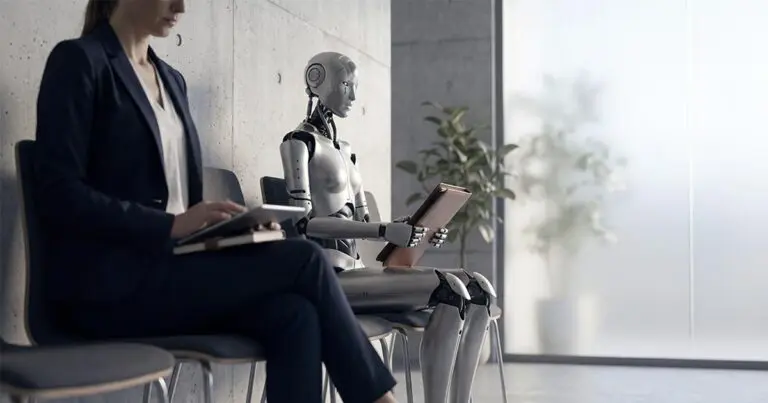
Oftentimes, the debate about AI in hiring is focused on the wrong question. Instead of asking whether candidates used AI during an interview, employers should ask how they used it.
As AI becomes part of everyday work, evaluating AI fluency, critical thinking, and human judgment may provide a stronger signal of future performance than trying to prevent AI use altogether.
Why Employers Are Reconsidering AI Bans in Hiring
AI is becoming part of everyday knowledge work
Generative AI is quickly becoming another productivity tool alongside search engines, documentation, collaboration platforms, and development tools.
Employees increasingly rely on AI tools to draft content, analyze information, write code, and accelerate routine work across nearly every business function.
If organizations expect employees to use AI after they’re hired, interviews should reflect that reality instead of assuming candidates work without modern resources.
Traditional interviews don’t reflect real work
Most employees don’t solve problems in isolation, they consult documentation, coworkers, and increasingly AI tools before making decisions.
Yet many interviews still evaluate performance as though work happens without access to any external resources, creating an environment that rarely mirrors the workplace.
That disconnect can make job assessments less predictive of how candidates will actually perform once they’re hired.
The conversation is changing
The question is no longer whether candidates used AI but how they used it.
Asking why they trusted an output, what they changed, and how they verified the results reveals far more than trying to detect AI usage. Those conversations measure judgment, and judgment remains one of the most valuable skills employers can evaluate.
What Does AI Fluency Actually Mean?
AI fluency is more than writing good prompts
AI fluency is the ability to use artificial intelligence effectively while understanding its strengths, limitations, and appropriate applications.
It includes prompt crafting, evaluating outputs, recognizing hallucinations, and protecting confidential information throughout the hiring process and on the job. True AI fluency is less about generating content quickly and more about using technology responsibly.
Judgment matters more than generation
Anyone can produce AI-generated content with a well-written prompt, but not everyone can recognize when that content is incomplete or incorrect.
High-performing employees improve, challenge, and validate AI outputs before acting on them rather than accepting the first response at face value.
Hiring for AI skills should prioritize critical thinking over content generation because judgment ultimately determines the quality of the final outcome.
Responsible AI use includes knowing when not to rely on AI
Responsible AI use means recognizing situations where human expertise should take precedence over automation.
Confidential information, regulated industries, and high-stakes business decisions all require employees to understand the limits of AI principles and apply sound judgment accordingly.
Not only that but employees are adopting AI rapidly, often faster than organizations are establishing governance, making AI literacy an increasingly important workplace competency.
Should Employers Allow AI During Job Interviews?
Not every interview should include AI
Not every assessment should permit AI assistance, particularly when employers need to validate foundational knowledge or role-specific expertise independently.
Certain technical tests, coding exercises, certifications, and integrity assessments are designed to measure capabilities that candidates should demonstrate without external support.
The goal isn’t to eliminate independent evaluation but to determine where AI-enabled interviews better reflect the realities of the role.
AI can improve the right interview exercises
Business writing, research assignments, case studies, data analysis, and presentation preparation often mirror the type of work employees perform every day with access to AI tools.
Allowing AI during these job assessments shifts the focus from memorization to problem-solving, communication, and decision-making. Rather than evaluating whether candidates can avoid AI, employers can evaluate how effectively they collaborate with it.
Make AI use transparent instead of hidden
Instead of attempting to detect AI cheating, employers should encourage candidates to openly explain how they incorporated AI into their work.
Asking why they chose a particular prompt, what they accepted or rejected, and how they verified the results creates a richer conversation than reviewing a polished deliverable alone.
Transparency helps hiring teams evaluate reasoning instead of rewarding candidates who are simply better at concealing AI use.
What Employers Should Evaluate Instead of AI Usage
Organizations should update interview scorecards to measure AI fluency rather than AI avoidance. The strongest candidates aren’t necessarily those who avoid AI—they’re the ones who demonstrate sound judgment while using it.
Employers can evaluate competencies such as:
- Prompt strategy and the ability to ask effective questions.
- Critical thinking when reviewing AI recommendations.
- Editing and refinement of AI-generated content.
- Decision-making that prioritizes human judgment when appropriate.
- Clear communication of the reasoning behind each decision.
These capabilities align naturally with skills-first hiring because they measure how candidates think, adapt, and solve problems rather than whether they completed an exercise without assistance.
Designing Better AI-Enabled Interviews
Give every candidate access to the same AI tools
If AI is part of the assessment, every candidate should work with the same AI tools under the same conditions.
Standardizing the experience creates a fairer candidate experience and ensures interviewers evaluate decision-making instead of access to premium models or personal subscriptions. Like any assessment, consistency makes comparisons more meaningful and defensible.
Evaluate the thinking, not just the output
The most valuable insight often comes from understanding how a candidate arrived at their answer rather than reviewing the answer itself.
Asking candidates to narrate their approach—or reviewing interview transcription and interview transcripts after the session—can reveal how they gathered information, evaluated alternatives, and made decisions.
This shifts the focus from the final deliverable to the reasoning that produced it.
Ask follow-up questions AI can’t answer
Strong interviewers should explore the decisions behind the work by asking candidates what they would change, what assumptions they questioned, and what risks they identified.
Those conversations quickly distinguish candidates who collaborated thoughtfully with AI from those who simply copied the first response they received.
The result is a more realistic evaluation of workplace performance than AI detection alone.
Managing the Risks
Prevent overreliance on AI
The biggest risk isn’t that candidates use AI, it’s that they rely on it without applying critical thinking.
Interviewers should look for evidence that candidates challenged recommendations, verified facts, and improved AI-generated content instead of accepting it at face value. Human judgment remains the differentiator between average and exceptional performance.
Protect confidential information
Organizations should establish clear guidelines for what candidates can and cannot enter into public AI systems during the hiring process.
Proprietary case studies, customer information, and sensitive business data should never be exposed simply for the sake of a job assessment.
A thoughtful AI interview policy protects both the organization and the candidate while setting expectations from the outset.
Match AI policies to the assessment
Not every evaluation should permit AI assistance, and employers shouldn’t replace every assessment with AI-enabled interviews.
Personality assessments, integrity assessments, and some proctored testing platforms or technical tests are intentionally designed to measure independent knowledge or behavior, making AI restrictions both appropriate and necessary.
The objective is to decide where AI reflects real work—not to apply the same rule to every stage of talent acquisition.
The Future of Hiring Will Reward AI Fluency
AI is becoming another workplace productivity tool
Artificial intelligence is following a familiar path established by spreadsheets, search engines, and coding assistants.
Each technology changed how work was completed without eliminating the need for expertise, experience, or sound decision-making. AI is likely to become another expected capability rather than a specialized skill reserved for technical teams.
Hiring should measure how people work
As AI becomes embedded in everyday workflows, hiring practices should evolve alongside it.
Organizations that continue evaluating candidates under conditions that rarely exist on the job may miss important indicators of future performance.
Measuring adaptability, critical thinking, and responsible AI use creates a more realistic view of how someone will contribute after they’re hired.
Better interviews produce better hiring decisions
The purpose of an interview isn’t to determine whether candidates can avoid modern technology, it’s to understand how they solve problems.
Evaluating AI fluency gives employers a clearer picture of judgment, communication, and decision-making than simply searching for signs of AI cheating.
As AI reshapes the workplace, the organizations that hire most effectively will be the ones that evaluate how candidates think, not just what they produce.
Is It Okay to Use AI During an Interview?
AI is changing the workplace, and the hiring process should evolve with it.
Rather than treating artificial intelligence as something to detect or prohibit, employers should consider where it can be incorporated into interviews to better reflect the realities of modern work.
Hiring for AI fluency instead of AI avoidance won’t be appropriate for every role or every assessment, but it may become one of the most effective ways to identify candidates who combine technology with the one skill AI still can’t replace: human judgment.
Looking to hire top-tier Tech, Digital Marketing, or Creative Talent? We can help.
Every year, Mondo helps to fill thousands of open positions nationwide.
More Reading…
- Why AI Has Made Job Interviews the Weakest Link in the Hiring Process
- The Hidden Costs of DIY Specialized Talent Recruiting
- Why Digital Transformation Failure Still Happens and What Talent Has to Do With It
- Social Media Manager Burnout: Why the Role Was Never Designed for One Person
- The Top AI Design Tools Every Designer Should Know To Get Hired in 2026
- Why Cloud Cost Optimization Is Driving New Hiring Priorities
- How Collaborative Coding Is Reshaping Tech Hiring & Redefining Technical Talent
- The Return of Specialized Tech Talent: Why Deep Expertise Is Back in Demand
- Anthropic’s Mythos Shift Signals the Rise of AI Governance Careers
- Why Technical Debt Is Becoming a Workforce Problem
- How to Become an AI Researcher: A Step-by-Step Career Guide
- The Legacy System Problem: Why Modernization Efforts Are Creating New Talent Gaps
- AI-Assisted Software Development Is Increasing the Value of Experienced Engineers